Showing posts with label Church of England. Show all posts

Thursday, January 20, 2022

Archbishop Cottrell the Climate Change Clown

Few things are both more contemptible and laughable than church leaders obsequiously aping the agendas of the globalist establishment.  How some clergy make “climate change” more their Gospel than the Gospel itself is certainly part of this sell-out behavior.

Take the Archbishop of York Stephen Cottrell.  Please.  The other day he was asked by a Canadian:

The Fifth Mark of Mission of the Anglican Church of Canada is “to strive to safeguard the integrity of creation and sustain and renew the life of the earth.” What’s your advice about how to motivate people in our pews to take positive action about climate change? (and what might that action as a church be?)

A clown question typical of the ACC being far more wedded to leftist ideologies than to the Gospel.  But Cottrell’s answer was even more clownish:

What a good question. Is there a more important question facing the world?  

What the….?  A supposedly Anglican Archbishop suggesting that the issue of climate change may be the most “important question facing the world?”  I think the Bible and the Creeds suggest some slightly more important questions.

It gets worse.  (Emphasis mine.) 

I think I would start by…two things…on the big picture level I think we need to teach much more about this. This needs to be not a kind of add-on to the Gospel; this is the Gospel…how we inhabit the world in the way of Christ…this is the Gospel. So, I’d want to preach and teach about it much more…

So Cottrell wants the church to go even more all in on pushing climate change agendas.  He even says “this is the Gospel.”

This is outrageous is what it is.  It is also puzzling.  Does he not see what an obsequious sycophant he is playing for everyone to see?  Does he not realize he makes a joke of himself when he says such banal blasphemies?  Does he care?
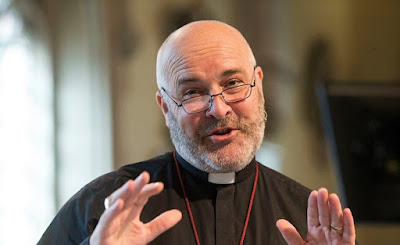

I knew Cottrell was bad news when he was appointed Archbishop of York.  But I did not expect him to be a clown.

This reminds me of another time I saw another Church of England cleric look silly in pushing climate change.  I won’t name names because I respect the woman in question, who has far more intelligence than Cottrell.   But one time, she drank the climate change Kool-aid a bit much and had a bad day. 

I was visiting an Oxford chapel on a Sunday morning back in 2007.  She happened to be the preacher.  And her entire sermon was on global warming.  (That’s what it was called back then.)

Well it so happened that very same Sunday was the most miserably wet and cold day that term.  So when, shivering from a long walk in the cold rain, I later entered her college chapel for Evening Prayer, I smiled and admonished her, “You and your global warming sermon!”

I don’t think she appreciated my humor.

To be fair, she normally led her chapel and preached with wisdom.  I say that although her churchmanship was decidedly different than mine.

Nonetheless, when clergy try to turn secular political agendas into Gospel issues worthy of much pulpit time, they not only do a disservice to the Gospel, they are likely to become silly . . . like Cottrell the Climate Change Clown.


Thursday, September 17, 2020

The Paradox of the Cowley Fathers

I’ve just finished reading Serenhedd James’ The Cowley Fathers which, as the subtitle announces, is “a history of the English Congregation of the Society of St. John the Evangelist.” I found it scholarly and for the most part very readable, even fun in spots.

The Society of St. John the Evangelist was an Anglo-Catholic monastic institution founded in Oxford in 1866 by Richard Meux Benson.  It dissolved with two active resident members in 2012.  For most of its life, it was based in the Oxford suburb of Cowley on the grounds now used by St. Stephen’s House, hence the affectionate moniker the Cowley Fathers.

Two paradoxes of its history struck me as I read James’ book, one positive, one not so positive.  First, the positive and downright Biblical paradox.  During its entire history, the Society of St. John the Evangelist had barely over a hundred members who remained in vows, “professions,” until death.  Yet in spite of its modest size it had a profound international impact, including in India, in South Africa, and in urban communities in the United States.  At home in England, it was a leader in the Anglo-Catholic Congresses and in providing retreats and spiritual direction to many, including C. S. Lewis.  More still can be said about their ministry.  The Cowley Fathers embodied the truth that God can work by many or by few.

The unpleasant paradox is one shared by much of the church during the 1960’s and later, that the Society watered down and cast off more and more of its heritage for a modern porridge, even including eventual majority support for women’s ordination and for the formation of Affirming Catholicism.  The motivation was to become more modern, relevant, and attractive, but the result turned out to be more repellant than attractive.  

While reading James’ narrative, it is not easy to discern just how this sad direction came about. But it is clear that Vatican II’s influence on the Church of England certainly influenced the Society as well.  Internally, much of the responsibility of the descent belongs to David Campbell, “the architect of most of the Society’s reforms of the 1960’s,” in James’ perhaps overly kind words, and then Superior General from 1976-1991.  He led the Society into terminal decline, acknowledging “we do not know whether or not there will be many chapters to follow” yet all the while expressing a positive spin on the decline that is pitiful and tragicomical in hindsight. 

Granted, Anglican monasticism as a whole declined in the post-war years; that decline was under way before the 60’s.  But one would think Campbell and the rest of the Society would have grasped that an attractive strength was its robustly catholic Anglican distinctiveness.  To exchange that for worldliness was foolish at best and surely accelerated the sad decline of the Society.  (Note that is my conclusion, not James’.)

Yes, the history of the Society of St. John the Evangelist has lessons for the church today, does it not?  If only those lessons were learned.

Friday, April 10, 2020

The “Bishop” of London Crucifies Again the Body of Christ

On Good Friday, almost 2000 years ago, both religious and secular authorities attempted to silence Jesus of Nazareth and to do so permanently.
They failed.
Yet through the centuries, they keep trying.  Various authorities, both secular and religious, have time and again sought to silence Holy Church, the Body of Christ.
They have failed again and again and again.  Jesus lives and reigns, and His Holy Church lives and reigns with him even though it may not seem so at times.
There is little question that those of a totalitarian mindset are trying to use the COVID-19 pandemic to silence the church and drive it out of the public square.  The Democrat Mayor of New York even threatened churches that do not comply with his edicts with permanent closure.
Yet in some ways the church is flourishing as it struggles in the midst of this pandemic both to do its part to guard public health and to do its duty for spiritual health.  Livestreams of excellent worship abound.  The glories of traditional Anglicanism especially are getting new and more widespread audiences.
But the petty totalitarians do not want to abide even that.  People, though a very few, are STILL going to churches and even livestreaming their worship?  How dare they!
Never mind that multitudes go to grocery stores and liquor stores and use mass transit where there is far greater risk of getting the coronavirus. The use of church buildings for worship is non-essential, don’t you know.
In London, one very small loophole was allowed.  If a priest lived on the premises of a church with internal access to the sanctuary, he could use the church building and livestream from it:
Because there are a very few churches in London Diocese where the church is accessible by an internal door from the clergy home, or can be accessed from the clergy home without leaving the curtilage of the church, we will encourage those – and only those – clergy to pray in their churches privately and to consider whether they could live stream their services from within the church building.
Peter Anthony of St. Benet’s Kentish Town was among those utilizing this loophole in a most winsome manner.  Fortunately, he recorded the Good Friday liturgy in his church when he still could.
For now he cannot without disobeying authority.  After the bleatings of the petty totalitarians, even that loophole has been taken away by the London College of “Bishops,” and that during Holy Week of all times:
…we are asking the limited numbers of you to whom the above applied, to stop all live streaming from your church buildings for the time being.
It feels extremely hard to ask this of you, this week of all weeks.  But you will know that some people believe that being in our churches to stream, even if it is accessed by a door in your home, is encouraging others to want to travel to their church, and for others to ask for churches to be open to the public. [GOD FORBID that people would ask for their churches to be open!! – ed.] We would not want to be seen to encourage any laxity in the requirement to stay indoors except for designated reasons, because this will save lives, and protect the NHS.
Thus, with the flimsiest of excuses, the “Bishop” of London seeks all the more to muzzle the church.  As if solitary priests livestreaming from their churches endangers lives and the NHS.
Well, apostate religious authorities attempted to use their authority and secular authority to silence Jesus, and that too on dubious pretences.  We should not be surprised when apostate “bishops” attempt to silence Holy Church and its faithful priests. 
We shall not be silenced.  We must not be silenced.  For, yes, lives are at stake.
For as the sufferings of Christ abound in us, so our consolation also aboundeth by Christ. And whether we be afflicted, it is for your consolation and salvation, which is effectual in the enduring of the samesufferings which we also suffer: or whether we be comforted, it is for your consolation and salvation. (2 Cor. 1: 5,6)

Tuesday, December 31, 2019

2019 Not a Good Year for EU Idolatry

As 2019 comes to a close, right-minded people can rejoice that Great Britain will be sovereign again having thrown off the EU.  The 2016 Brexit referendum was finally followed up in 2019 by the resounding victory of Boris Johnson, who made “Get Brexit Done” his chief campaign platform, and the accompanying resounding defeat of those who did not respect the 2016 referendum and sought to obstruct Brexit.

But Robert Innes, the Bishop of the Church of England’s Diocese in Europe, is not so happy about that.  If you really want to read his whinging, you can go to Anglican Ink for that.

Now one may think my headline about “EU Idolatry” might be overwrought.  But it is prompted by the photo of Innes’ idolatrous mitre at Anglican Ink (with apologies to Anglican Ink for, well, stealing it):


Yes. That is an outline of Europe front and center on his mitre.  It is appalling that anyone claiming to be a Christian bishop would wear such a mitre.  Jesus is Lord, not any state, and not the EU.  And his kingdom is not of this world.  To have Europe – or the U. S. or a world globe for that matter – so displayed on a mitre is idolatry (not to mention in bad taste, also a cardinal sin in Anglicanism).

(And if that is the outline of his diocese, that is no excuse.  Jesus is Lord, not the area of a diocese.  If I were somehow a Bishop of Texas, I would not dare to have an outline of Texas so prominantly displayed on my mitre.)

But then the Socialist Globalist politics most Church of England bishops so adore is part of the idolatry of the state which has so plagued Europe and the world, is it not? No wonder those bishops so deplored Brexit.

Anyway, let us rejoice all the more that the brazen idols of Statism, Globalism and of the EU had a bad year in 2019.  May the 2020's be a decade in which millions upon millions become all the more freed from their illegitimate power.

Wednesday, December 18, 2019

Apostate Liar to be Archbishop of York

That the Church of England is sinking lower and lower is evidenced by the next Archbishop of York, Stephen Cottrell, who is not only an apostate, who not only practically drives out orthodox clergy, but is also a liar. But those do go together, don’t they.
Andrea Williams, Synod Member and Chief Executive of Christian Concern [Emphasis mine]:
This is a Bishop who endorses gender transition in primary school children.
Stephen Cottrell has told multiple clergy on multiple occasions that if they don’t like the approach of the diocese on human sexuality they can leave the CofE.
Stephen Cottrell has attempted to deny this, but there are more than thirty clergy who know what they heard him say on multiple occasions.
Several clergy in Stephen Cottrell’s diocese are out of communion with him because of his stance on human sexuality. One resigned over this. For him now to be appointed as Archbishop of York is a final insult to those who want to hold onto Biblical teaching in the CofE.

I can hardly add to that.

Friday, September 27, 2019

An Odd Statement on Brexit from the C of E House of Bishops

First, I have to get credit where credit is due.  On its face, the statement on Brexit by the Church of England House of Bishops is commendable.  The result of the Brexit referendum should be respected.  And even Archbishop Welby of all people has called out the Remoaners for their “whingeing”.  And care should be taken in the language used in discussing Brexit.
But the statement has the air of a body that is above the fray when Church of England bishops have been anything but.  Church of England bishops are almost all Remainers, and quite a few merit being dubbed Remoaners.  Further, some of their language towards those who back Brexit has been *cough* uncharitable as Cranmer notes.
You know if I were to give a sermon on the sin of unrighteous anger, I would feel like a pretentious hypocrite if I did not acknowledge during it that I struggle with anger.  So how can the House of Bishops give a statement like this without clearly acknowledging and, yes, apologizing for the very public Remoaning amongst them in the years since the referendum?
Nonetheless, the statement is a pleasant surprise.  Better late than never.

Friday, August 30, 2019

About Bishops Who Remoan

I’ve oft stated that bishops and other church leaders should be very selective and careful in making political pronouncements.  The most important reason is that most political questions are ones on which faithful Christians can and do disagree. Therefore for a church leader to use their position to take sides on such political positions is a sin against church unity.
That also can harm evangelism.  Now as St. Paul and I pointed out yesterday, we do not water down truth for the sake of evangelism.  But we also do not dilute our message or repel people with questionable political posturing.
So to frequently pontificate on political matters on which faithful Christians can and do disagree asks for division, people simply walking away, and ineffective evangelism.  Combine that with the more grievous  sin of wimping out on Gospel truth or departing from it altogether, and you are asking for the collapse of a church.
Well, all of these sins have been committed by most bishops of the Church of England in recent decades, and, sure enough, that august institution is in slow motion collapse.  (Yes, I freely concede that rampant apostasy is a far more important factor in this than rampant political pontificating.)
The public pitiful remoaning of C of E bishops gives us an example of the foolishness of such political pontification.  A majority of those voting in the Brexit referendum voted for Brexit.  And many of those who did not now want just to get it done with.  And after Teresa May’s years of dithering, who can blame them? 
Yet, instead of keeping their own counsel (as I would as a church leader – I very much am for Brexit but realize faithful Christians very much disagree on that question as Christian teaching addresses that only in a tangential manner if at all), C of E bishops are opposing their people. And when they seem more exercised against Brexit than they are against false teaching and when, further, they are often sources of false teaching, well what is to attract and keep people other than the beautiful buildings and choirs?
Instead, political remoaning and often apostate bishops are surely driving people away much as the Leftist and apostatizing mainline Presbyterian Church drove me away.
So the remoaning bishops not only seem a bit silly, they are actively harming the church.  Likewise for all church leaders who abuse their positions to push for political causes on which faithful Christians can disagree.

Wednesday, July 10, 2019

Noll on Moral Equivalence and False Teaching in the Church of England

Stephen Noll has written a good and succinct piece on how Biblical and anti-Biblical views of sexual morality and marriage are treated as morally equivalent under the guise of “good disagreement” in the Church of England.
“Good disagreement” along with “mutual flourishing” of course means LibChurchers can teach and practice whatever apostasies they please while traditional orthodox have to put up with it and get little in return, especially little when it comes to bishoprics and deaneries.
The Archbishop of York along with the Archbishop of Canterbury is endorsing this sham.

But, as Noll points out, there are matters in which truly good disagreement means the likes of, say, Martyn Percy are called out as St. Jude did, utterly rejecting the notion that false teaching is morally equivalent, and then (although Noll does not spell this out) exercising church discipline against the false teachers.

Yes, the Church of England is too far gone for any hope of church discipline against apostate clerics.  It serves as a negative example illustrating that false teachers must not be treated as morally equivalent – which Noll considers “moral equivocation” – but must be confronted, suspended, and, when necessary, defrocked with all diligence.  Otherwise false teaching will spread like gangrene eventually maiming or killing a church if said church discipline is too long delayed and too infrequently applied.

As I’ve oft said, a church that does not care enough about truth to discipline does not care enough about truth. Treating false teaching as “good disagreement” is deadly disagreement against God’s word.

Thursday, July 05, 2018

Anglican Troll of the Year

Yes, about half of 2018 remains. Yes, I have never given such an award as Anglican Troll of the Year before.  But Jules Gomes’ post supposedly reporting that the Church of England’s General Synod may abolish the Holy Trinity to make nice with Muslims demands recognition.
Yes, it was satire and hilarious, lampooning a number of parties in the Church of England.  More importantly, in spite of giveaway names in it (I particularly like “Rev’d Janus Pliable, Rector of St Simplicio’s Church, Bishopsbottom, London.”), it was such good satire that some thought it was true.  One might say it was too close to true.
 We are aware of a blog entitled 'Church of England's Synod may abolish Holy Trinity to include Muslims'.
 Apparently some commentators appear not to have realised the author intended it to be a joke. For the avoidance of doubt, this article is entirely without basis of fact, and is published marked as 'satire'.
 The agenda for the July 2018 General Synod can be found here, including details of all Private Member Motions listed for debate. 
The Church of England remains fully committed to the doctrine of the Trinity. 
Thus Gomes’ post and eliciting that denial from the Church of England already wins the Anglican Troll of the Year award.
--- 
NOTE:
“Troll” often has a negative meaning. It should not be so interpreted here.  Rest assured that this award is given out of great admiration for very effective and impactful satire.  Well done, Fr. Jules!

Monday, April 30, 2018

John Fenwick on When Unity Efforts Fail

A number of papers from the aforementioned Anglican Patrimony Conference have been posted.  The one most intriguing to me is by John Fenwick, Primus of the Free Church of England and a key player in attempting to coordinate orthodox Anglican efforts in the U. K.

He reveals some very interesting history from the inside of the Canterbury-Rome unity push in the 70’s:

It was in the heady days of ARCIC 1. The Final Report had been sent around the Provinces of the Anglican Communion. Most of the responses were positive. It was expected to be officially endorsed at the forthcoming Lambeth Conference. The Vatican response was expected imminently. There was a feeling that something momentous was about to happen.

Prior to my appointment to Lambeth I had been lecturer in Christian worship at Trinity College, Bristol. Shortly after my arrival in the Ecumenical Affairs office, Christopher asked me to do some preliminary thinking about a liturgical project. (As Christopher put it, there’s no point in having a dog and barking yourself.) The project was what liturgical form the restoration of communion between the Anglican Communion and the Roman Catholic Church might take. That was a heady request for a junior staff member! The most recent unity scheme around was the Covenant for Unity based on the Ten Propositions. That had proposed a day of liturgical events including the consecration of bishops. I remember working with that model and envisaging a service where the Pope and the Archbishop of Canterbury might jointly consecrate the first of a new generation of bishops whose Orders would be recognised by both Churches.

We were that close! Or at least so it seemed to some of those closely involved.

In retrospect that moment was a high water mark. The tide has been going out ever since.

As some may remember, the Vatican’s response not only did not come before the next Lambeth Conference as hoped; it did not come until 1991.  And not only the timing, but also its content was disappointing.

Even more disillusioning has been the Church of England’s liberal drift since then.  That leads Bishop Fenwick to make an interesting hypothesis:

I want to suggest that the Vatican’s 1991 response fits a pattern that has characterised ecumenical endeavour in the past half century – namely that unity initiatives have been halted by the refusal of what one might call the more conservative partner to act, and that as a result, the other partner has felt itself free to move further away from the historic Christian consensus.

I do not claim that what I am going to say has been rigorously historically tested, nor am I able to do so here, but I think the possibility of a pattern is worth considering.

And that pattern is simply that there seem to have been several occasions when the more conservative partner in a dialogue, by failing to take bold action, allowed the less conservative partner to move further away from traditional faith and practice.

And he gives other examples of this occurring, including failed efforts between Old Catholics and Eastern Orthodox.

This pattern indeed merits consideration.  When jurisdictions are in the midst of unity efforts, their focus is often on how would merger/intercommunion affect us.  And that is certainly important.  But how it would affect the other party and the whole church, the Body of Christ, should not be overlooked.  And Fenwick does not let us ignore that, often for the disappointed party, a “move further away from traditional faith and practice” occurs after unity efforts fail.

Of course, in such cases we do not know what would have happened if unity efforts succeed.  For example, in the case of the Church of England and Roman Catholics, would Rome had been importing more liberalism to its harm? Would more Protestant-minded Anglicans feel pushed out of the Church of England?  I personally suspect the failure of ARCIC did more harm that what might have happened if it succeeded, and Fenwick seems to think that as well.  But we do not know.  And, yes, jurisdictions have to consider the stresses and pressures greater organizational unity may cause.  I sometimes wonder if the Anglican Church in North America, in its well meaning haste to bring Anglicans together, has not given such issues enough consideration.  If not done right, organizational unity can beget more disunity.

Nonetheless, Bishop Fenwick well reminds us that the good of the other party should be considered.  (And the bishops of the Reformed Episcopal Church have done just that in joining and remaining in ACNA.)  We should avoid causing sister churches to stumble by turning them away without very good reason.

Care should also be taken in missionary efforts where there are existing Anglican jurisdictions.  Accordingly, Fenwick, in his conclusion, let it be known he still has mixed feelings about the consecration of orthodox bishops in the U. K. outside of existing jurisdictions.


Whether one agrees or disagrees with Fenwick’s paper (I agree, at least for the most part.), it contains most interesting insight not often presented.  Read it all.

Monday, April 23, 2018

“Stringent Consequences”?? Oh My!

From the Sunday Times via Ancient Briton:

The Church of England has warned its American sister church that it could be kicked out of the global Anglican family if it forces priests to use a gay-friendly marriage ceremony that relegates the importance of bearing children.

In a strongly worded eight-page letter, William Nye, the Church of England’s secretary-general, told the Episcopal Church that it could face “stringent consequences” if it replaced the marriage rites in its Book of Common Prayer with a gender-neutral ceremony that removed all reference to procreation.

Stringent Consequences?!? My, oh, my!  Only one sugar cube with their tea at Lambeth!  That’ll show ‘em!

Pardon my snark, but fifteen years of seeing the Church of England in inaction since that fateful year of 2003 has made me slightly skeptical about any alleged will power of that august institution when it comes to apostates.  Warnings that once might have made one pause now just make one laugh.

Which, on reflection, is very sad.  I remember when I and other orthodox Anglicans actually had some hope that the Church of England would help set the Anglican Communion aright….


I best move on.  Neither temper nor depression becomes me.

Friday, February 16, 2018

For Lent the Church of England Urges Giving Up . . . Plastics

No, this is not satire.  I have not been fooled by a Babylon Bee article.  The Church of England really is encouraging giving up plastics for Lent.

Oh, and look:

The Church of England has created a calendar for a plastics-free Lent, each day bearing either an environmentally-themed Bible verse or a suggestion on how to avoid buying plastics.

Yes, there really is a Church of England calendar for a plastics-free Lent.  See for yourself.

What prompted this move of the . . . some sort of spirit?  Why the EU, of course, as the New York Times reports with a straight face: “In December, the European Union announced binding waste-reduction targets for member nations, with particular emphasis on plastics.”

This reminds me of all the libchurchers pushing the UN’s Millennium Goals just before and after 2000.  Yes, by all means, let the One World establishment set the agenda for the church.


With this cloying clown attempt to abuse Lent to appear with it and “woke,” the Church of England might as well add “Me, too” to the liturgy.

Thursday, December 21, 2017

An Episode from the Smearing of George Bell

Others have followed the slanderous injustice done to the late Bishop George Bell by the Church of England.  So I will defer to them.  The ashes of Archbishop Cranmer is one who has done yeoman’s work on this matter.  Another I must praise is (You might want to sit down now.) the Dean of Christ Church Martyn Percy.  Some readers might remember I am not exactly a fan of him.  But I must give credit where credit is due, and his article in Christian Today is revealing and courageous.

This slice of life from the Dean is particularly revealing:

On the October 21, 2015, I had been rung by the then Secretary-General of the Archbishops' Council and of the General Synod of the Church of England, Sir William Fittall. It was Fittall who told me, over the phone, that a 'thorough investigation' had implicated Bishop George Bell in an historic sex-abuse case, and that the Church had 'paid compensation to the victim'. Fittall added that he was tipping me off, as he knew we had an altar in the Cathedral dedicated to Bell, and that Bell was a distinguished former member of Christ Church.

Fittall asked what we would do, in the light of the forthcoming media announcements. I explained that Christ Church is an academic institution, and we tend to make decisions based on evidence, having first weighed and considered its quality. Fittall replied that the evidence was 'compelling and convincing', and that the investigation into George Bell has been 'lengthy, professional and robust'. I asked for details, as I said I could not possibly make a judgement without sight of such evidence. I was told that such evidence could not be released. So, Christ Church kept faith with Bell, and the altar, named after him, remains in exactly the same spot it has occupied for over fifteen years, when it was first carved.

And good on Christ Church Oxford for that.  But shame on the Church of England.  From this episode we see the sorry smear they were engaged in: telling people they had “compelling and convincing” evidence against Bell, but without revealing it, and now we know that evidence was very far from convincing.

Yet, on the basis that flimsy, puffed-up evidence, George Bell’s good name was trashed and removed from a number of monuments and institutions.  One may suspect there were motivations behind this, such as posterior covering, that had little to do with evidence.


People are pushed to resign over truly “compelling and convincing” allegations of sexual abuse and rightly so.  People who smear good men, even good dead men, on the basis of flimsy evidence and uncorroborated allegations should resign as well. 

Tuesday, December 19, 2017

New Bishop of London: “Safeguarding is at the heart of the Gospel.”

No, it’s not. 

In fact, the most cursory knowledge of history and of current events informs that believing and preaching the Gospel is a good way to get killed or at least blackballed.  Anyone who preaches the Gospel and insists on the orthodox preaching of the Gospel by clergy has a snowball's chance of becoming a bishop in today’s Church of England, token flying bishops excepted . . . for now.

To be fair, Sarah Mullally was referring to churches safeguarding the young and vulnerable from abuse.  Certainly, churches have important roles to play in that regard.  But is safeguarding “at the heart of the Gospel”?


No.

Tuesday, December 05, 2017

Why the AMiE Ordinations are Necessary

The Anglican Mission in England (AMiE) will hold its first ordination service Thursday in London.  Which begs the question: are these ordinations outside the Church of England necessary?

Yes for a number of reasons, but one is enough – orthodox traditionalists, either evangelical or Anglo-Catholic, are less and less welcome among the clergy in the Church of England.  Oh you mossback orthodox laity, of which there are many, do keep sending in those offerings please.  But if you are called to holy orders…

Is there a single robustly orthodox Church of England diocesan bishop anymore?  I’m aware of none.  And more and more candidates for holy orders are having experiences like one told in the Times:

One was blocked from ordination because he expressed his conviction that every church leader should believe and teach that Jesus is the only way to be saved.  He was told that he didn’t have a broad enough understanding of the different traditions in the Church of England.

Related is an excellent dissection of Libchurch “dialogue” from once CofE Anglo-Papalist John Hunwicke:

Their idea of 'discussion' or 'dialogue' meant them shouting abuse until their foes fell silent. They demanded that we 'hear their experience' purely as a preliminary to getting out their cudgels. They would never engage in rational argument because, happy pantomaths, they already knew every answer. They had made bullying into a fine art. To disagree with them was but to manifest one's own psychological problems - one's phobias and hang-ups and prejudices. What defences had we, or the methods by which Divinity had hitherto been done on the banks of the Isis or even of the Cam, against this ruthless and Stalinist totalitarianism and its Dahlek-like readiness to ex-ter-min-ate?

Yes, “exterminate” is a strong word.  But robustly orthodox Church of England clergy are at the very least an endangered species in several dioceses thanks to apostate bishops who will not have them.  That’s what “inclusiveness” looks like.

So although I enthusiastically support orthodox ministry in the Church of England, an outside strategy is necessary as well.  In some areas of the U.K., there is hardly much choice about it any more.

Thursday, July 27, 2017

Sign the “The Movement for a Renewed Orthodox Anglicanism” Letter


British Anglicans have asked Christians around the world to endorse the movement for renewed orthodox Anglicanism, asking supporters to add their names to the letter published in the Daily Telegraph this week calling for the reform and renewal of the Church of England, Church in Wales and Scottish Episcopal Church.

I am glad that it has been made clear that overseas signers are welcome to join Bishop Nazir-Ali, Primus John Fenwick, Rev. Gavin Ashenden and hundreds of others. Let’s make it thousands!  I’ve signed and urge my good Anglican readers to sign, too.  The letter, the signers, and the opportunity to sign may be found here.  The text of the letter follows.

Recent actions in the General Synod in pursuit of a culture that denies biblical ethics, as they have been practised and understood “at all places and in all times”, have caused many Anglicans great concern.

There are times, particularly in the face of social disintegration, when it is the duty of the Church to be counter‑cultural. The failure of the House of Bishops to uphold the teaching of the Bible and of the Universal Church in this area is very disappointing, if not surprising.

Booing of traditionalists and the levels of personal abuse aimed at them during the Synod have only deepened mistrust between the different sides.

There are now effectively two opposed expressions of Anglicanism in this country. One has capitulated to secular values, and one continues to hold the faith “once delivered to the saints”.

We and others stand with the majority of faithful Anglicans across the globe, in prioritising Scripture and the unanimous teaching of the universal Church over secular fashion. We note the results of this same conflict in North America, even as we look for and pray for a similar renewal of orthodox Anglicanism and of Anglican structures in these islands. 

Tuesday, July 25, 2017

Orthodox Anglican Laity Standing Up in Britain

A significant factor in the apostasy and decline of most mainline denominations in the West is that the laity, even orthodox laity, put up with apostasy instead of putting their foot down.  Or when they finally did speak up in numbers, it was too late.

So it gladdens my heart to see British Anglican laity taking action in the aftermath of the recent and already infamous General Synod of the Church of England.

The lay led Parochial Church Counsel (PCC) of St. John, Newland in Hull has publicly called on the Archbishop of York to repent of his role at Synod and has cut off parish donations to the Diocese of York in the indefinite/eternal meantime.  Good!  A necessary first step in combating apostasy and error is to stop funding it.

Laity are also playing a significant role in alternative synods already meeting.  These meetings include Anglican clergy and laity both inside and outside the Church of England.  How churches get involved in these synods is interesting and instructive [Emphasis mine]:

Churches have joined the synod by means of PCCs passing a motion: ‘As a PCC that is determined to uphold the Jerusalem Statement we commit to an Anglican synod of churches whose PCCs have likewise resolved to uphold the Jerusalem Statement. As an Anglican synod we will send representatives to confer, pray and assist PCCs in said synod as needful. We will seek to ensure our mutual support is in deed as well as word, and therefore enthusiastic, missional, financial and prayerful.’

By having churches join the synod via PCC resolutions, we ensure that lay people are fully involved in decisions and leadership. Bitter experience has shown that organisations almost exclusively led by Anglican clergy become talking-shops! Our churches see the Jerusalem Declaration as a valuable rallying point. Some churches have additional doctrinal commitments. In addition to the main synod meetings – attended by all our PCCs, there are occasional Clergy Chapters. These offer fellowship and training to clergy who are happy to sign a statement similar to the PCC motion.


Indeed, laity must make a stand and get involved if denominations and churches are to avoid apostasy and error.  One practical reason is it is easier to a lay person to disobey an errant bishop than it is for clergy.  The pressure on clergy to go along to get along can be great.  One example is a Church of England cleric under pressure from Justin Welby himself had his name withdrawn from a recent letter as reported on Anglican Unscripted #310 (about 2 minutes in).  It is far easier for a layperson than for clergy to tell Justin Welby and his ilk where to go.


So good on the lay leadership of St. John, Newland and on other Anglican laity taking a stand in Britain.  Their efforts aided by the power and grace of God are needed if orthodox Anglicanism is to survive and thrive in the UK.

Wednesday, July 19, 2017

A Timely Letter from British Orthodox Anglicans UPDATED

Yesterday, I mentioned that John Fenwick, Primus of the Free Church of England, in his new book Anglican Ecclesiology and the Gospel urges orthodox Anglicans to work together in England.  The same evening this letter that demonstrates just that came to my attention, signed by Fenwick, Gavin Ashenden, and Andy Lines among others from various groups:

Many will share our dismay at the recent decisions of the General Synod of the Church of England and the pursuing principles, values and practices contrary to Holy Scripture and church Tradition.

Given the persistent failure of the majority of the House of Bishops to fulfil the God-given duties which they have sworn to discharge these tragic developments were, sadly, not wholly unexpected.

Accordingly, and in preparation for such eventualities we, as some of those committed to the renewal of biblical and orthodox Anglicanism have already started to meet, on behalf of our fellow Anglicans, to discuss how to ensure a faithful ecclesial future.

We now wish that we have done so to be more widely known.
Our number is drawn from bishops, clergy and laity, from across Great Britain and from a breadth of traditions. Much more importantly, however, we meet joyfully united by a shared endorsement of the terms of the Jerusalem Declaration.

We will meet again, as planned and with external facilitation, mediation and episcopal advice, in October. It is our intention to welcome on that occasion an even greater diversity of contributors.

I am glad to see this collaborative effort and will watch in October with interest.  I’ve heard proposed either by Fr. Ashenden or Bishop Fenwick (My memory is fuzzy.) a college of orthodox bishops.  Perhaps that will be on the agenda.

UPDATE:


Primus John Fenwick has issued a follow-up letter.

Wednesday, July 12, 2017

What Should Have Happened at General Synod

The focus of the past Church of England General Synod, and of coverage of it, was sex and gender issues.  And as deplorable as the measures passed in those areas are, what is more deplorable is what General Synod did not do.  To me at least, the silence is deafening.

General Synod, to my knowledge*, spent not one minute addressing the Philip North affair.  The Synod, along with the Archbishops of Canterbury and York, bent over backwards to make gays and transgenders welcomed and affirmed.  Sentamu was particularly loquacious in that regard.  But where was the welcome affirming inclusion for traditional Christians?

The North debacle sent the strong message that when it comes to diocesan bishoprics, traditionalists need not apply.  Oh, traditionalists are welcome . . . to stay in their ghettos.  But forget about moving on up.

There was perhaps not a more urgent matter for General Synod but to counteract that message, to make clear that what happened to North should not have happened and will not happen in the future.  A censure of the Dean of Christ Church Oxford would have been appropriate, too, but I am really dreaming there.

But instead, nothing.

People can put up with a lot if they know they are welcomed and appreciated.  But if given the opposite message, if treated like third class citizens, most people will eventually walk away.  The Church of England should not be surprised if traditionalists of both Anglo-Catholic and Evangelical stripes soon walk away in greater numbers.  And the Church of England and General Synod will only have itself to blame.


*I’ve searched and searched for any mention of the North affair at General Synod and have found none.  If I missed something, feel free to let me know in the comments.