Showing posts with label illuminated manuscripts. Show all posts

Wednesday, January 30, 2019

Apocalypse Illuminated by Richard K. Emmerson

A focus of my studies in Oxford this past Michaelmas Term was medieval eschatology, particularly the exegesis of the Book of Revelation in illuminated Apocalypses.  I soon discovered this area is more complex than I expected perhaps because the medieval church did not insist on much dogma in eschatology beyond the teaching of the Nicene Creed that Jesus “shall come again with glory to judge both the quick and the dead; whose kingdom shall have no end.” Thus there was space for a lot of interesting diversity in the details of eschatology.  And events such as the year 1000 and invasions from Muslims and Tartars certainly goaded speculation on the details of end times.

At the same time, the many failed predictions, especially those that involved dates, assisted more conservative eschatologies to reassert themselves from time to time.  And most of the commentary texts of medieval illuminated Apocalypses reflect more conservative interpretations even as those, too, differ.
In short, medieval eschatology and its artistic expression is a fascinating but not at all easy area of study.  This is reflected in disagreements and occasional errors in modern scholarship.  Speaking of which, I am having to unlearn a thing or two I learned in Oxford!
So I appreciate a recent (and reasonably priced) acquisition to my library, Apocalypse Illuminated, The Visual Exegesis of Revelation in Medieval Illustrated Manuscriptsby Richard K. Emmerson, published just last year.  I’ve come across a number of excellent books in my studies on the subject, but Emmerson’s stands out as the best overview. It certainly well aids and clarifies the study of a complex subject.
Emmerson goes over the similarities and differences between various illuminated Apocalypses very well and uses a multitude of illustrations well in so doing.  His speculations as to what may have motivated bursts of creation of these lavish books, which clustered around certain times such as the third quarter of the 13thcentury, is also helpful.
And Emmerson is not at all merely derivative but advances scholarship.  One example stood out to me.  He boldly states that a number of very reputable scholars are mistaken in attributing a prediction that the end would come in 1260 to Joachim of Fiore.  He attributes that failed prediction to Joachimite followers instead and noted Joachim himself was adverse to setting dates though he was certainly bold in other respects.
Do be aware that, as Emmerson makes clear, Apocalypse Illuminated focuses on how these manuscripts interpreted the Book of Revelation and on the influences behind those interpretations. Thus, though well illustrated, this is not an art book.
I could praise Apocalypse Illuminated further.  But I will just say this: if I were to lead a seminar on medieval illuminated Apocalypses and accompanying eschatology, I would choose this book as theintroductory text.  If there is a more scholarly, more readable, and more up-to-date overview in this area, I for one am not aware of it.

Wednesday, September 28, 2011

Medieval Whimsy in Serious Places

Today at the Treasures of Cuthbert in Durham Cathedral, I saw a 13th century copy of Gratian’s Decretum complete with an illumination of some odd imaginary creature, a friendly dragon perhaps?

Since Gratian was the dominant canon law reference of the time, that’s a bit like seeing a modern lawyerly tome illustrated with Spongebob.

Now I am certainly aware that many medieval manuscripts, even of religious import, are whimsically illustrated. The Luttrell Psalter, which I intend to study in some detail, stands out in that regard. But I certainly did not expect such in a medieval law book.

Such can also be found in English cathedrals and churches. In Hexham Abbey is stone carving of a jester and of a fox preaching to other animals. And this on a chantry near the altar no less. At the crossing of Wells Cathedral is the famous stone carving of a man with a toothache.

I have not yet come across much scholarly commentary on frequent medieval whimsy in illuminated manuscripts and in places of grave, even holy import.

But I have a theory . . . which I may promulgate at a later time.

---

Housekeeping: I did promise you a surprise about this time. I am studying in England again. And my posts will focus mainly on that experience for a while.

Thursday, August 02, 2007

A History of Illuminated Manuscripts

I purchased A History of Illuminated Manuscripts by Christopher De Hamel towards the end of my Advent 2005 trip to England (at the British Library if memory serves me correct). But I didn’t thoroughly read it (as opposed to just looking at the excellent illustrations) until now.

I am thoroughly impressed with this book. Its scholarship is impressive and helpful in my preparations to study medieval history at Oxford. And the thoughtfully written bibliography and through indexing of the manuscripts illustrated assist further studies. Even though it’s not on my official reading list and is certainly not a light nor compact book, I’m packing it and taking it with me.

But, as scholarly as this work is, if one simply wants an attractive coffee table book on the subject, this can certainly be one. If one wants a very readable, engagingly written, well illustrated introduction to illuminated manuscripts, this is for you as well.

There is even some helpful guidance on collecting the more available manuscripts such as Books of Hours. And as the Fellow Librarian of Corpus Christi College, Cambridge and with his 25 years experience in evaluating manuscripts for Sotheby’s, Dr. De Hamel’s knowledge is not just theoretical.

As if that is not enough to recommend purchase, I notice it’s on sale at Amazon at the above link at a very reasonable price as I write this.

Tuesday, July 31, 2007

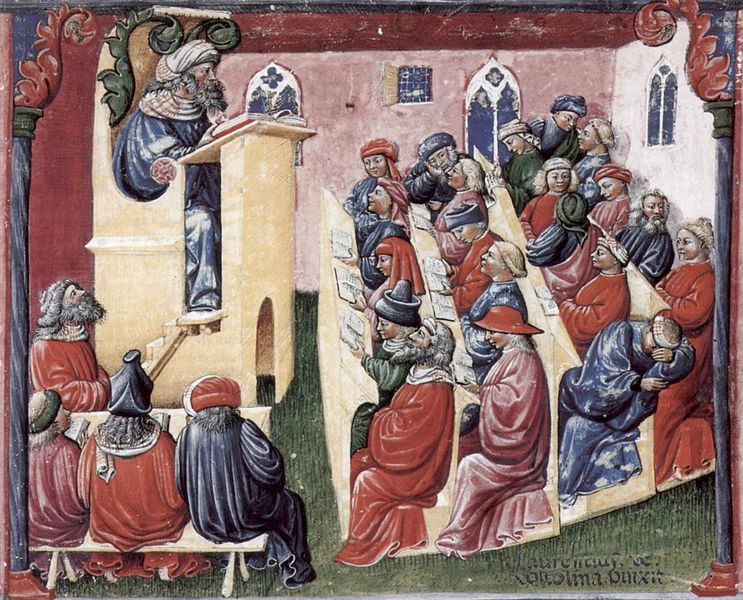
University Lectures: The More Things Change . . .


This is a 14th century manuscript illumination portraying Henricus de Allemania lecturing on Aristotle. The illumination appears in his commentary on Aristotle's Ethics. Note that the students are following along in their manuscripts . . . or are engaged in conversation or sleep.


By the way, less than one month until Oxford.


(A larger version of the above illumination may be found here.)